Sync incremental orders with equal-watermark handling
Load three orders, append an order at the same timestamp, and keep reruns idempotent.
Audience and outcome
For users syncing changing data with timestamp watermarks, tie-breakers and idempotent reruns.
Before you start
Complete the shared preparation, then prepare the resources below.
| Resource | Requirement |
|---|---|
| Source and target | Two separate PostgreSQL business databases. A setup identity has CREATE/INSERT on the dedicated databases; iJob’s source connection needs SELECT, and its target connection needs corresponding write privileges. |
| Data | An id primary key, integer amount and TIMESTAMP updated_at. Do not reuse a TEXT watermark column. |
| Worker | An available Worker; set task retries to 0 while checking each run. |
Configuration
| Field / setting | Example value |
|---|---|
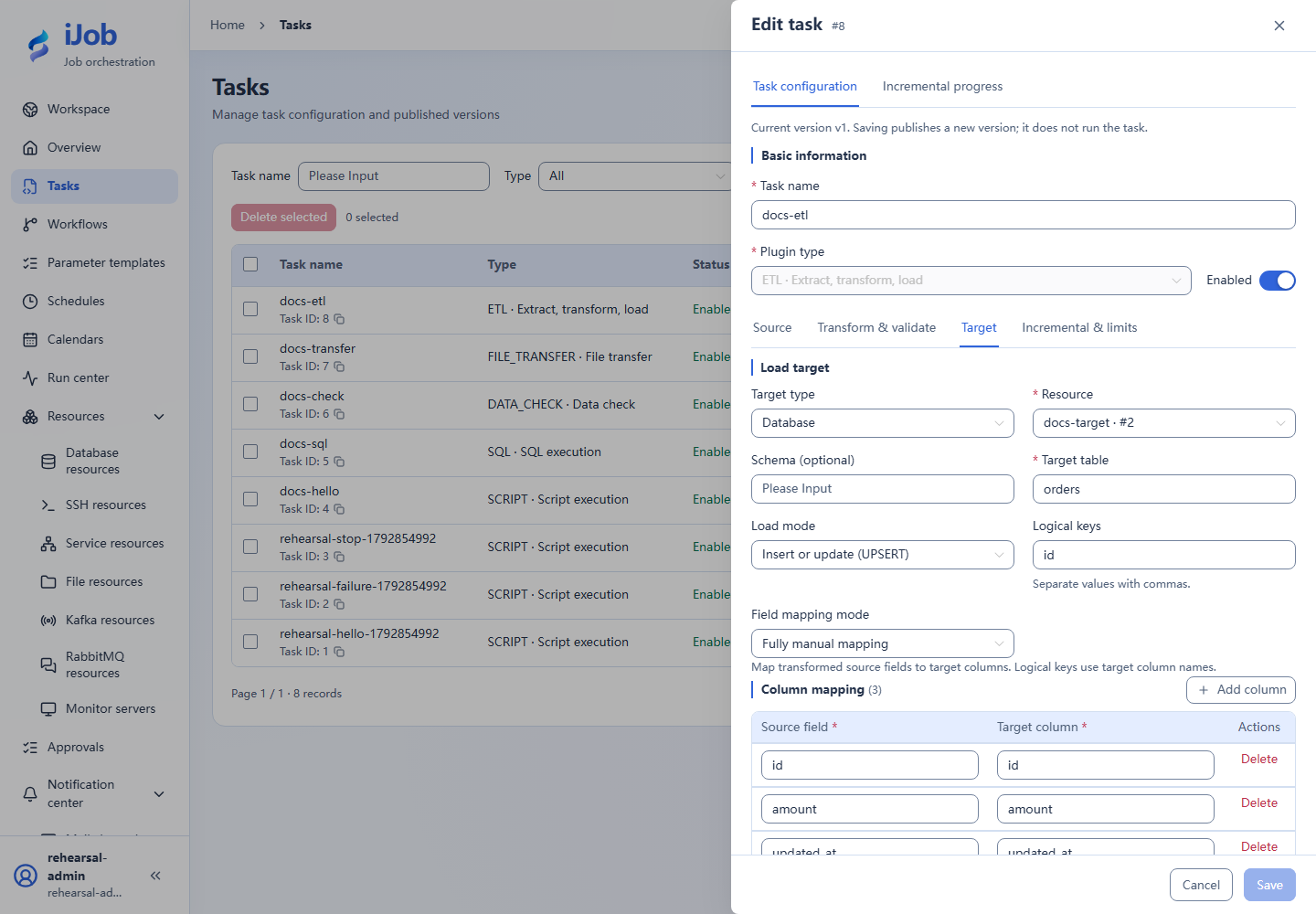
| Source / target type | DATABASE / DATABASE |
| Target / write mode | orders / UPSERT |
| Logical key | id |
| Mappings | id→id; amount→amount; updated_at→updated_at |
| Initial incremental setting | Disabled |
| Checkpoint key | A new key dedicated to this tutorial, such as docs-orders-incremental-01 |
Steps
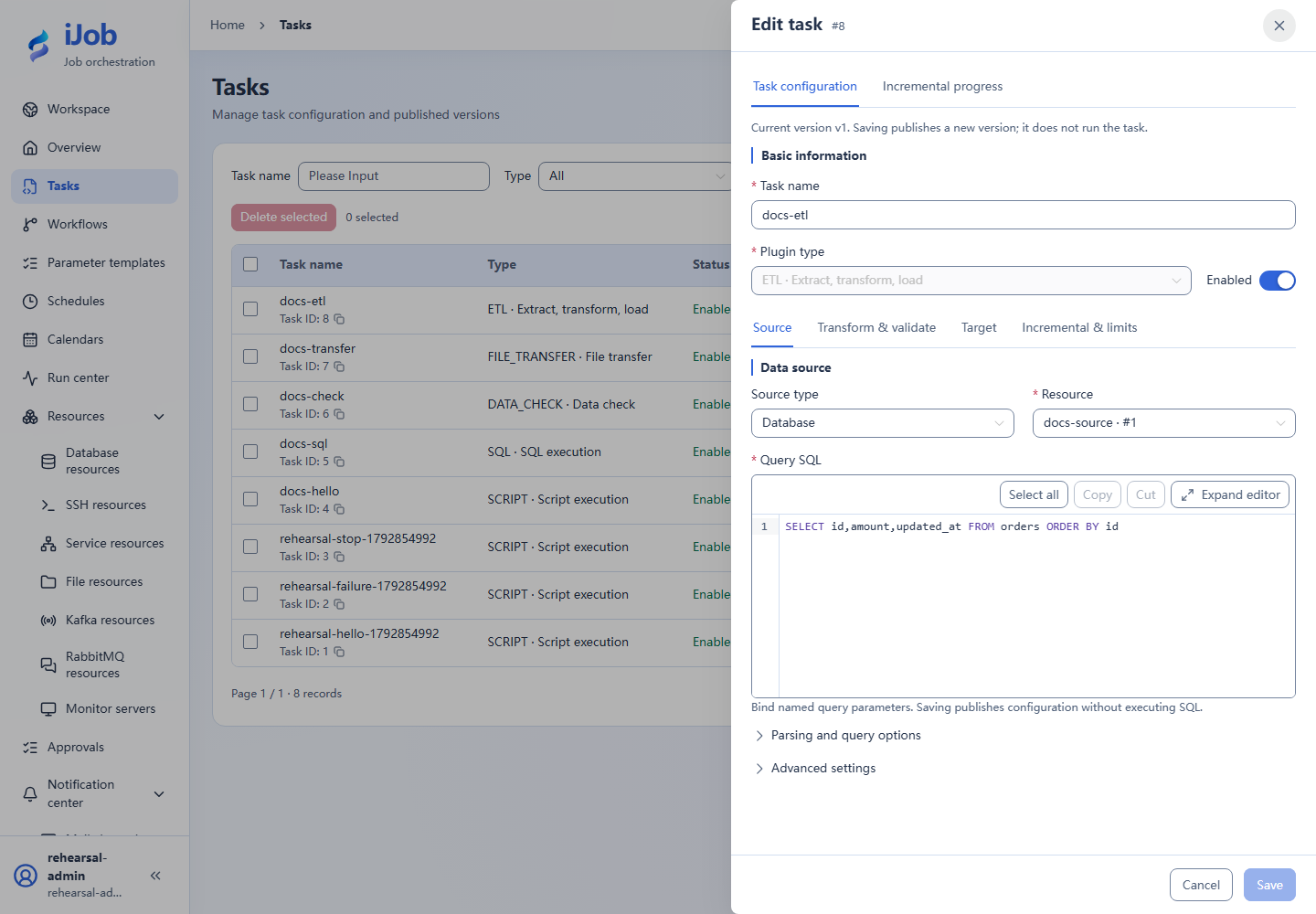
1. Create source and target tables
Prepare two fresh dedicated business databases. Run setup as a database identity with CREATE/INSERT privileges; the task may use a different read-only source account. If a table already exists, choose a new dedicated database/table instead of replacing it.
Run table creation and inserts in the source business database:
CREATE TABLE orders (
 id INTEGER PRIMARY KEY,
 amount INTEGER NOT NULL,
 updated_at TIMESTAMP NOT NULL
);
INSERT INTO orders VALUES
 (1,100,TIMESTAMP '2026-01-01 00:00:00'),
 (2,200,TIMESTAMP '2026-01-02 00:00:00'),
 (3,300,TIMESTAMP '2026-01-03 00:00:00');
In the target business database, create only the empty table, without source sample inserts:
CREATE TABLE orders (
 id INTEGER PRIMARY KEY,
 amount INTEGER NOT NULL,
 updated_at TIMESTAMP NOT NULL
);
Grant SELECT on the source table to iJob’s source account and the required read/insert/update privileges on the target table to its target account. Create and test separate database resources. The setup identity need not be used for routine task execution.
2. Configure and run a full load
Create an ETL task using the configuration table. Use:
SELECT id,amount,updated_at FROM orders ORDER BY id;
Save/publish, trigger manually, wait for the final status and query the target:
SELECT COUNT(*) AS rows, SUM(amount) AS amount FROM orders;
Expect 3 rows totaling 600. Repeat the full load: the target remains 3 rows/600.
3. Configure the watermark and stable ordering
Enable increments. Set watermark field updated_at, type TIMESTAMP, initial value 2025-12-31T00:00:00, tie-breaker field id and initial tie-breaker value 0. Use a new checkpoint key. Set the upper-bound query to SELECT MAX(updated_at) FROM orders. Replace the source query with:
SELECT id,amount,updated_at FROM orders
WHERE (updated_at > CAST(:etlLastWatermark AS timestamp)
 OR (updated_at = CAST(:etlLastWatermark AS timestamp) AND id > :etlLastTie1))
 AND updated_at <= CAST(:etlUpperWatermark AS timestamp)
ORDER BY updated_at,id;
Keep filtering and ordering aligned with the watermark configuration.
4. Establish the incremental checkpoint
Save/publish and run manually. A new checkpoint rereads the initial three rows; UPSERT leaves 3 rows/600. Inspect incremental progress and confirm the dedicated checkpoint key.
5. Append an order at the same watermark
Run in the source database:
INSERT INTO orders VALUES (4,400,TIMESTAMP '2026-01-03 00:00:00');
Run the incremental task again, then inspect the target. Expect 4 rows totaling 1000 and exactly one row with id=4.
6. Rerun without new data
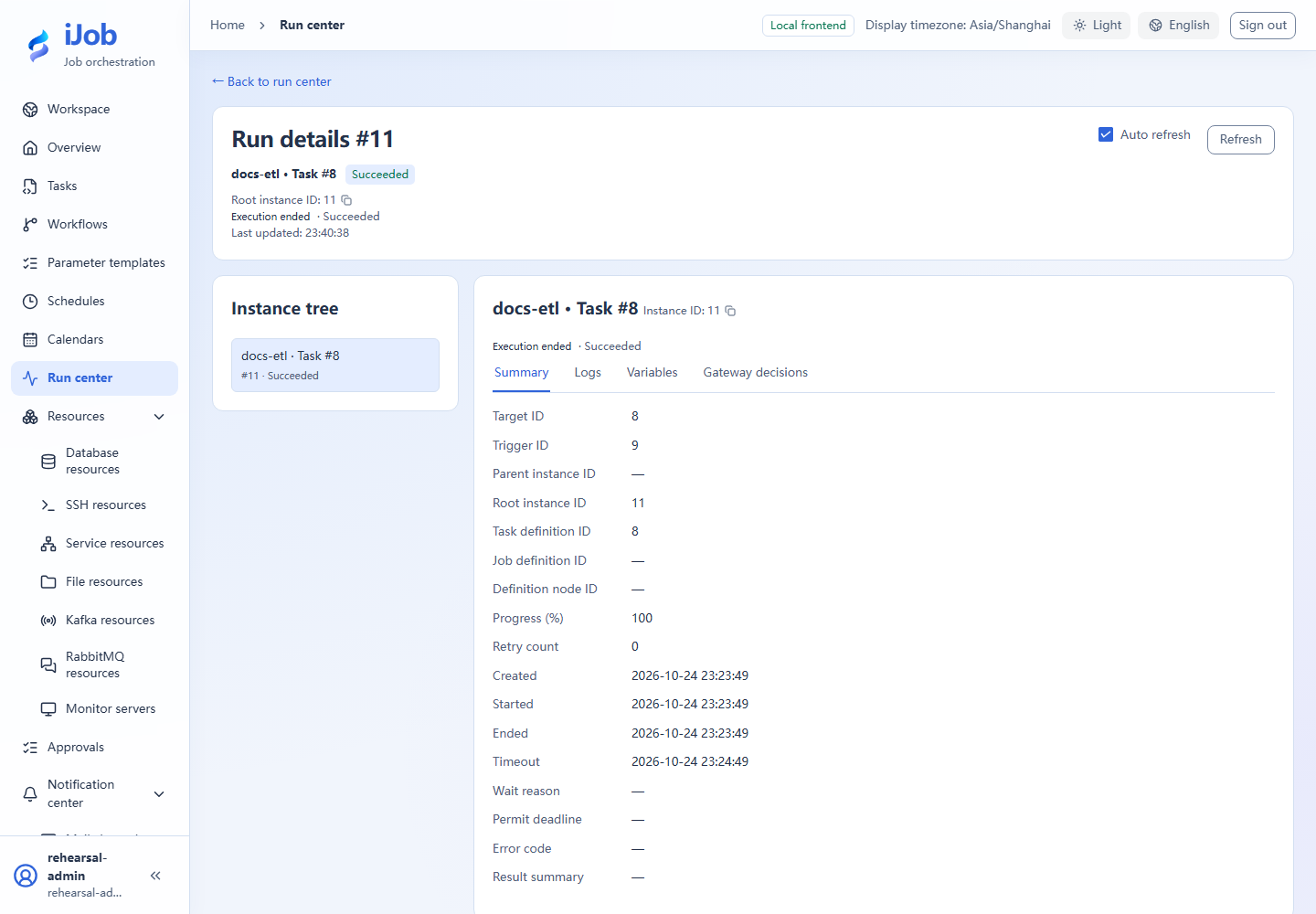
Run again without modifying the source. The target remains 4 rows/1000. Check target data, the checkpoint and the actual definition version, as well as the instance status.
Expected results
| Check | Expected value |
|---|---|
| First and repeated full load | 3 rows, total 600 |
| First incremental checkpoint | 3 rows, total 600 |
| Append id=4 at the same watermark | Extract and insert 1 row; target has 4 rows, total 1000 |
| Empty rerun | Extract 0 rows; target remains at 4 rows, total 1000 |
| Keys | Exactly one row each for ids 1, 2, 3 and 4 |
Common failures
| Symptom | Action |
|---|---|
| Timestamp mismatch | Use TIMESTAMP and retain the explicit CASTs; JSON strings need database type conversion. |
| Missing equal-watermark rows | Check the tie-breaker field, initial value and ORDER BY. |
| Target write failure | Inspect committed data and checkpoint state before rerunning with UPSERT; target writes and checkpoint updates are separate commit boundaries. |
Safety and cleanup
Disable any tutorial schedule. Wait for active instances before removing the tutorial task and dedicated data. Do not reset checkpoints still used by other tasks.
Version and limitations
Applies to 1.0.0 with PostgreSQL source and target: full load, a TIMESTAMP watermark with id tie-breaker, an equal-watermark append and an empty rerun. Use a fresh checkpoint key for each independent exercise. File increments, other database dialects and SCD2 are separate extensions.
Interface reference
These are actual interface references for this capability. Names and instance IDs may differ from your run; follow the steps and expected results for extensions.